
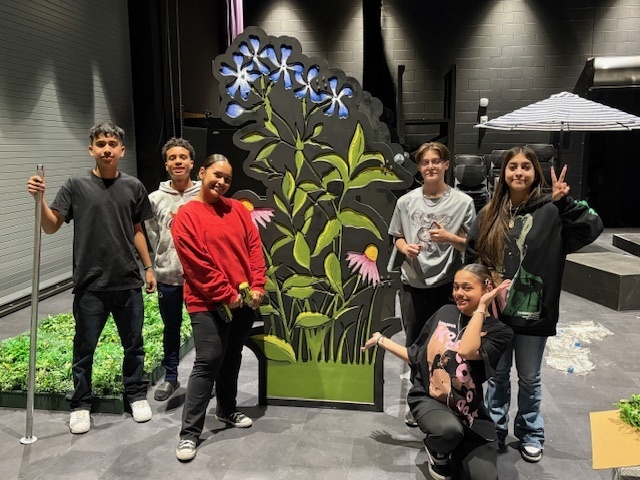
When the Dallas Zoo needed innovative, engaging art installations for their new I Spy Butterflies exhibit, they turned to a creative source of creativity: the students of Village Tech Schools in Duncanville.
What began as a request for a few pieces of art, quickly blossomed into a full-scale collaboration that resulted in eight large art installations designed and built entirely by students. The young artists transformed the exhibit into an interactive wonderland that educates and inspires visitors about the fascinating world of pollinators.
The student-created installations range from a giant butterfly life cycle arch to interactive build-a-bug stations for children. Each piece underwent rigorous design processes, including multiple prototype presentations to the Zoo representatives, followed by revisions and refinements, mirroring real-world professional design experiences.
We spoke with Elizabeth Podany, M.Ed., Village Tech Director of Design and Innovation, and student artists about this unique collaboration:
Q: How did this partnership with the Dallas Zoo come to be?
A: The partnership began when the Dallas Zoo reached out to us with an exciting opportunity. They were looking for student-created art installations for their upcoming I Spy Butterflies exhibit, which opened in April.
The Zoo’s goal was to feature creative, meaningful work made by young artists. They chose Village Tech for this project because of our unique approach to learning through design and real-world experiences.
It’s been incredible to watch the students’ ideas take shape and become part of an experience that will be seen by thousands of zoo visitors.
Q: What are some of the projects the students worked on?
A: Phase 1 projects include a Build-a-Bug Interactive for the Children’s Playground, where kids can create their own insects by mixing and matching different parts. There’s also a Giant Butterfly Life Cycle Arch, a Butterfly Location Map painted on concrete showing global butterfly habitats, and Stacked Mural Boxes featuring different biomes and their pollinators. Students also created camouflaged butterfly sculptures hidden throughout the exhibit, photo backdrops with monarch butterfly and bat wings, and various interactive games teaching children about pollinators.
Q: How excited were the students when they found out they would be working on this exhibit?
A: Hannah Lambert, one of our student artists, shares: “When we were first told about it, I remember feeling a little skeptical it would go anywhere, but slowly, excitement in our group grew as we went through the design processes and presented them to the panel. We were relieved, excited, and anxious when we were told we made it through, and our group would be putting something in the exhibit. I’m so proud of my team for working through iterations, learning new skills, and installing a beautiful piece of work.”
Miranda Martinez adds: “When our teacher first introduced the project to us, none of us realized just how big it would become. As a group, we were all excited to start something new and have the opportunity to create something for the Dallas Zoo. Now that it has come to an end, we are all incredibly proud of what we’ve accomplished, and we’re thrilled that our work will be displayed for everyone to see.”
Q: What has been the most rewarding part of this project for students?
A: The students mention various rewarding aspects. Simone Alverado found value in “being able to have an opportunity to work with so many different tools. We used teamwork to work on many things for our project, which was really fun.”
Hailey Glover appreciated “learning new skills that I didn't know I could do and not giving up even with many challenges.”
For Micah Stoker, it was “definitely working with my team. They were open to my ideas and were also friendly and fun to be around. Having them on my team lifted up my spirits and made my time working on our project fun.”
Q: What will zo-goers experience when they visit the exhibit?
A: The goal of the project was to create experiences for zoo-goers ages eight months to 80 years. We wanted to have a variety of installations that all communicated different things. The butterfly exhibit is beautiful, engaging, and educational. It’s definitely worth a visit.
Visit the Exhibit
The I Spy Butterflies exhibit featuring Village Tech students' artwork was open this fall and will reopen in spring 2026. The exhibit is included free with zoo admission.